

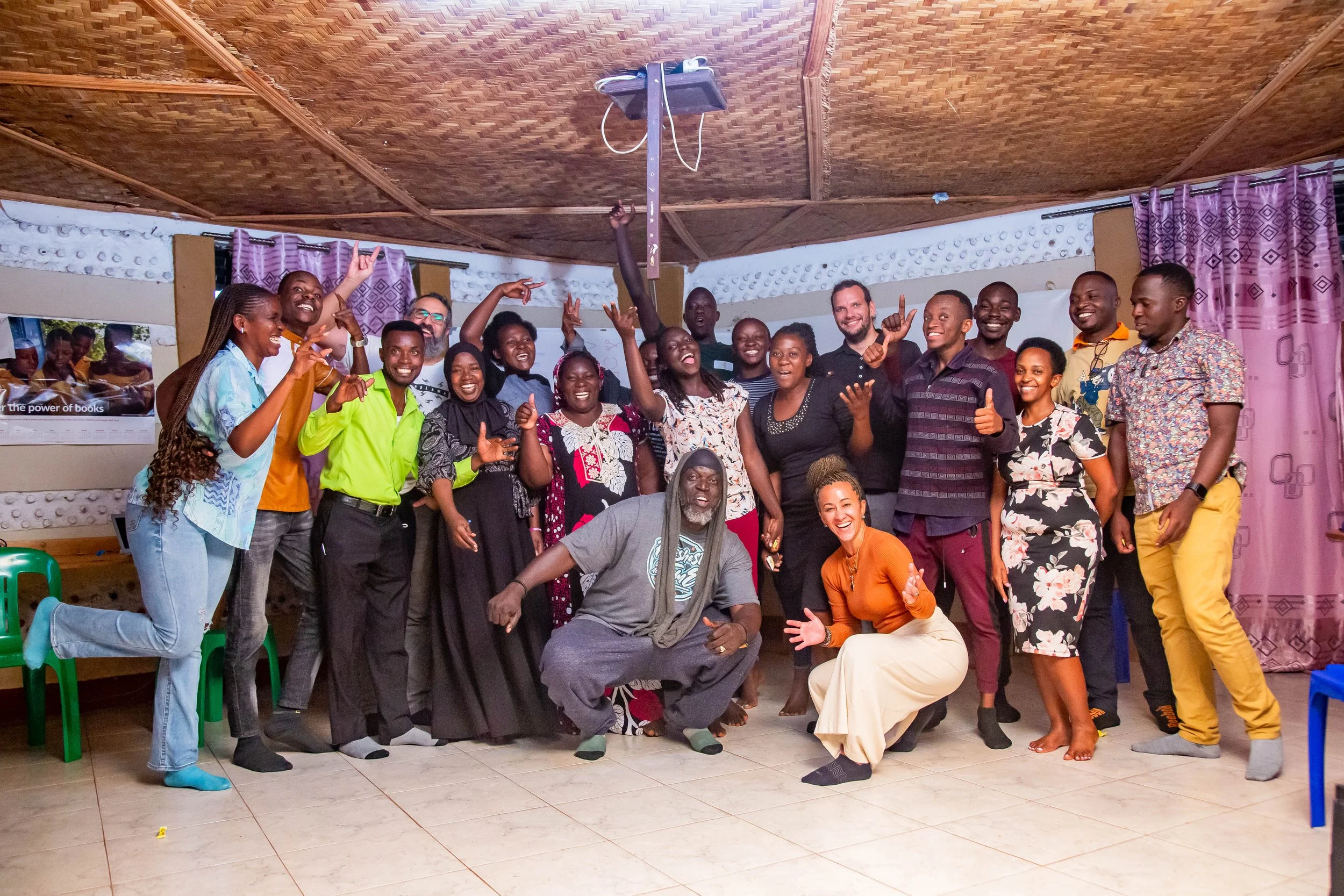
Our Accelerator Program
Nine weeks. One business. Real change.
The SAF Africa Accelerator is not a course about entrepreneurship.
It is nine weeks of building your enterprise in the room, alongside eleven other changemakers who are doing the same thing.
You arrive with a business and an obstacle. You leave with a plan to remove that obstacle, a costed roadmap for your first year after the program, and a cohort that knows your work well enough to keep helping once it ends.
The 2026 cohort begins October 12. Applications close September 21st.
What makes this different
Most accelerators teach. This one builds.
We cut the lecture time to twenty minutes per session. Everything else is you, working on your own enterprise, with facilitators moving between rooms and peers working the problem with you.
Every week produces something you keep. Nine weeks, nine pieces of work, all of it stacking into two deliverables you take with you.
Nothing is assigned that does not feed the final package.
How the nine weeks flow
Every Thursday. Prework is released. One short video, one reading, one worksheet. Thirty minutes, no more.
Every Monday, 90 minutes. Twenty minutes of framing. Fifty minutes building in your pod. Twenty minutes reporting back what you decided and what you are still stuck on.
Every Friday, 60 minutes. Two enterprises take the hot seat, and the cohort solves their problem live. Every enterprise gets the hot seat twice across the program. Open office hours follow.
Three times across the program. A thirty-minute one-to-one session with a facilitator, scheduled after weeks 2, 6, and 8.
The Curriculum
Week 0: Onboarding Baseline assessment, pod assignment, and your barrier statement. One sentence naming the single thing most in the way of your enterprise growing.
Week 1: Human Foundation, Mindset and Vision Where the work starts. You cannot build something durable on an unexamined why. You leave with a vision statement and your barrier spoken out loud for the first time.
Week 2: Trauma Informed Leadership How you lead when a funder withdraws, when staff leave, when the money runs short. Practical, rehearsed, not theoretical.
Week 3: Lean Model and Impact Logic Your business model and your impact model on one canvas, because in a community enterprise they are the same question. You also set up your project workspace, and from this week on every piece of work you produce is filed there.
Week 4: Customers, Sales and Distribution You will complete five real customer conversations between Monday and Friday and bring what you learned back to the group.
Week 5: Unit Economics and Breakeven Your numbers, not a worked example. You will calculate your own breakeven in the session.
Week 6: Cash Flow, Pricing and Funding Readiness A cash flow projection covering your next twelve months of operation, and one pricing decision made and defended.
Week 7: Story, Brand and Reach One story written, one brand asset produced, one platform configured live. Hands on, not slides.
Week 8: Barrier Sprint and Roadmap The centerpiece. Your pod spends the session working one member's barrier at a time until every enterprise has a written plan to remove it. Friday you sequence and cost your One Year Roadmap out of the work you have been filing since week 3, and you learn how to run against it once the program is over.
Week 9: Pitch, Demo and Commitments You build your own deck. No template. Monday is rehearsal, Friday is the showcase with external guests, and the program closes with your 90 day commitments read aloud to your pod.
What you walk away with
A Barrier Removal Plan. You come in knowing what your enterprise needs next. You leave with a plan to get there. The move, the cost, the owner, the deadline, and the signal that tells you it worked.
A One-Year Roadmap. Four quarters, each with named goals, owners, dependencies, costs, and review dates. Built in a live tool, not a document that sits in a folder.
Your own numbers. A breakeven model and a cash flow projection for your next twelve months of operation, built on your real figures.
An operating cadence. A one page working rhythm for your enterprise. What gets reviewed, by whom, how often, and what to do when the plan and reality stop matching. You will have been running this rhythm for nine weeks before you name it.
A pitch deck you designed. Yours, in your voice, structured your way.
Eleven people who know your work. Your pod signs a pact in week 9 to keep meeting after the program ends.
What you walk away with
A Barrier Removal Plan. You come in knowing what your enterprise needs next. You leave with a plan to get there. The move, the cost, the owner, the deadline, and the signal that tells you it worked.
A One-Year Roadmap. Four quarters, each with named goals, owners, dependencies, costs, and review dates. Built in a live tool, not a document that sits in a folder.
Your own numbers. A breakeven model and a cash flow projection for your next twelve months of operation, built on your real figures.
An operating cadence. A one-page working rhythm for your enterprise. What gets reviewed, by whom, how often, and what to do when the plan and reality stop matching. You will have been running this rhythm for nine weeks before you name it.
A pitch deck you designed. Yours, in your voice, structured your way.
Eleven people who know your work. Your pod signs a pact in week 9 to keep meeting after the program ends.
What we ask of you
This is a working program. It asks for real time and real honesty about where your enterprise actually is.
Time. Two live sessions per week, 2.5 hours total, for nine weeks. Plus roughly 2 hours of prework and build time between sessions. Budget five hours a week.
Attendance. You may miss two Monday sessions. Beyond that we will talk about whether the timing is right for you.
An operating enterprise. You need something running, even if it is small and early. This is not a program for ideas that have not been tested with a customer.
Your real numbers. Weeks 5 and 6 do not work if you cannot bring actual revenue and cost figures. Rough is fine. Absent is not.
Deliverables on time. Each week's work is due before the following Monday, and your pod can see it.
Connectivity. A stable enough connection for video sessions and a device you can work on.
Who this is for
Changemakers running community enterprises in Africa.
You have a business or a project that is already operating. You have customers or beneficiaries. You have hit a wall, and you know roughly where it is.
You are willing to say out loud what is not working, in front of eleven other people, and let them help you fix it.
Twelve places. We keep the cohort small on purpose.
Funding
Every changemaker who completes the program successfully receives a $200 implementation grant.
The grant is released against the first milestone in your One Year Roadmap. Not at graduation, but when you take the first step. This is working capital, not a prize for finishing.
At the week 9 showcase, three enterprises receive additional awards of $800, $500, and $300, judged by external guests.
We check in with every changemaker at 90 days to see what the grant bought and what moved.
Timeline
| Milestone | Date |
|---|---|
| Applications open | September 1 |
| Applications close | September 21 |
| Interview invitations sent | By September 23, 2026 |
| Interviews | September 24 – October 2, 2026 |
| Cohort announced | October 5, 2026 |
| Week 0 onboarding | Week of October 5, 2026 |
| Program begins | October 12, 2026 |
| Showcase and graduation | December 11, 2026 |
| 90 day check-in | March 2027 |
Session calendar
Sessions run Mondays and Fridays for nine weeks.
| Week | Monday | Friday |
|---|---|---|
| 1. Human Foundation, Mindset and Vision | Oct 12 | Oct 16 |
| 2. Trauma Informed Leadership | Oct 19 | Oct 23 |
| 3. Lean Model and Impact Logic | Oct 26 | Oct 30 |
| 4. Customers, Sales and Distribution | Nov 2 | Nov 6 |
| 5. Unit Economics and Breakeven | Nov 9 | Nov 13 |
| 6. Cash Flow, Pricing and Funding Readiness | Nov 16 | Nov 20 |
| 7. Story, Brand and Reach | Nov 23 | Nov 27 |
| 8. Barrier Sprint and Roadmap | Nov 30 | Dec 4 |
| 9. Pitch, Demo and Commitments | Dec 7 | Dec 11 |
How to apply
The application takes about forty minutes. We ask about your enterprise, your customers, your numbers as they stand today, and the obstacle you would most want to solve in nine weeks.
Write it plainly. We are not looking for polish. We are looking for a real enterprise and a real problem.
Shortlisted applicants have a thirty-minute conversation with a facilitator before final selection.
Frequently Asked Questions (FAQs)
-
No, but you need to have operated. Customers, beneficiaries, a pilot, a season of sales. Something that has met the real world.
-
Sessions run in English. If you can follow a conversation and ask a question, you will be fine. Tell us in the application if you have concerns.
-
No. The program is free to accepted changemakers.
-
Every Monday session is recorded. Friday clinics are not, because they are working sessions. Two absences are fine. More than that and we should talk.
-
One seat per enterprise. Bring your co-founder into the work between sessions.
-
Your pod pact, your 90 day check in, and the SAF alumni network. The roadmap is built to be used, not filed.